In light of what went on today, rather than comment, I just give you this quote from Thomas Jefferson in his Proposal for Virginia Constitution:
"No free man shall ever be debarred the use of arms"
This week I would like to discuss water and the "rule of 3's".
Actually there are two rules of 3. The first one has to do with what we need to live. You can live 3 weeks without food. (Some of us can live A LOT longer than that), 3 days without water, 3 hours without shelter (in a hypo- or hyper-thermic situation), and 3 minutes without oxygen. To put this in realistic terms, if you have a power outage in the winter, and have a heat pump, it makes more sense to think about how you will keep your family warm than how you will save the food in your non-functioning freezer/refrigerator. As Cody Lundin states in his very informative and funny book, "98.6 Degrees, or How to Keep Your Ass Alive", water and shelter are paramount to regulate your core body temperature. In our area, winter is not so much of a problem if you can be indoors and out of the wind. Summer is a different matter. In our summer temps, without air-conditioning and without water, it's not going to be pretty.
Everyone who asks me how to begin to prepare for a "grid down" situation knows that I always say. Start with your water. A minimum to store is 1 gallon per day per person just for basic living. Don't forget your animals, they will be useful as well as pets. I have 4 dogs who collectively use 1 gallon per day. So that means I need 4 or 5 gallons per day of potable water. WHAT! That's 150 gallons per month. How can I possibly store that much, you ask? You don't.
That brings us to the second rule of 3's.
I think it was an old Indian saying that you need 3 ways of doing something in order to be sure you can accomplish what you need. (more if you can)
In the case of water, you might have rain barrels underneath your downspouts - you'd be amazed how fast a 55 gallon garbage can fills up. You might turn off the intake valve to the hot water heater before the water becomes polluted, and then open the lowest faucets in your home to collect the water from the hot water tank. Maybe you have a large bath tub or a jetted tub. Plan on using a double layer of plastic drop cloth duct taped to the tub with the vents and drains duct taped beforehand. Or just clean the tub with clorox and go for it. Or you could buy what's called a "Water Bob" which is a large food grade plastic bladder that fits inside a normal sized tub. Cost about $20. Maybe you have a free flowing stream near your house, or a lake or swimming pool. Some of this water you can use as-is for basic cleanliness and toilet flushing etc. For drinking purposes, we need to go a little further down the path.
Most of those water sources will need to be purified somehow for drinking. The simplest is boiling. Bring a gallon of water to a full boil for 8 - 10 minutes. Allow to cool unless you want to make coffee, tea, or cook or wash/rinse your dishes with it.
Next is chemical purification. Plain, unscented Clorox is a good and readily available method. Eight drops per quart of water, shake well, and allow to stand for 30 minutes. You can remove the chlorine smell/taste by using a filter pitcher like Pur or Britta (note: they DO NOT remove bacteria or other impurities). Swimming pool water MUST be filtered due to the shock and other chemicals in the water for long term use.
Next is filtering. There are Berkey filters which can do 2 1/2 gallons in a very short time. Each one can filter 5500 gallons of water before needing a filter change, but they can cost $200 or more. There are personal water filters, such as the Life Straw which will filter water for one individual for about a year and cost only $20. I have one of these for each member of our family.
As you can see, there are many things to consider when starting to plan for the worst, hope for the best. Sometimes it's just a matter of thinking of easy solutions to difficult problems. If you have questions, please come and see us at the store, or call/e-mail and I will contact you. Our phone number is 336-944-3933, and our e-mail is patriotaims@gmail.com.
Anna

Wednesday, January 16, 2013

Wednesday, January 9, 2013
I was talking to a customer in the store on Monday about how to store medications for a survival situation when my daughter chimed in with, "You ought to write a blog". So here it is. I'm not sure how it will go, but what I plan is to let you know about an interesting article I have read related to food/water storage, medicinal herbs, foraging, alternative power and lighting options. Really, anything to do with preparedness. I will also try to find an appropriate quote that relates to what is currently going on in our lives.
This quote is from Abraham Lincoln.
"The people of the United States are the rightful masters of both Congress and the Courts, not to overthrow the Constitution, but to overthrow the men who pervert the Constitution"
This week I was reading a Facebook post by "Survival for Blondes" (yeah, I know...but she's really good). She had included an article from Ezine by Mike Kuykendall about how to determine if you are a "Prepper" or a "Survivalist"
He maintains that a prepper is concerned about everything from a natural disaster to the hyperinflation that will follow an economic collapse. They are prepared for anything that MIGHT happen. They can be anyone from the guy next door that you would never imagine to be a "Whacko", to the full-blown "Doomsday Prepper".
The Survivalist, on the other hand, takes it to the next level. In addition to food, water, etc., the survivalist will stock up on guns and ammo (bullets, beans and band-aids), and have a plan for a retreat from a populated area, or a plan to "bug-in" if their home is deemed to be safe. Survivalists believe that there WILL come a time when they will definitely have to defend themselves, their families and their food/supplies.
There is a lot of overlap between the two categories. Those that are more into self-defense and concerned about societal collapse lean more toward the survivalist end of the chain. Those more concerned with economic collapse or "merely" a power grid or supply chain failure would be more comfortable with the prepper tag.
For my part, I know that I am a survivalist and have been calling myself one since the 1970's. Now that you know the difference you can choose. Even if you don't believe in Zombies (which I don't) or that the end of the world will be happening very soon, you will make a choice whether to prepare for an emergency, such as hyperinflation or economic collapse, or to remain unprepared. Even if you make no choice, you have really chosen to remain unprepared.
If you'd like to read his whole article go to http://EzineArticles.com/?expert=Mike_Kuykendall
This quote is from Abraham Lincoln.
"The people of the United States are the rightful masters of both Congress and the Courts, not to overthrow the Constitution, but to overthrow the men who pervert the Constitution"
This week I was reading a Facebook post by "Survival for Blondes" (yeah, I know...but she's really good). She had included an article from Ezine by Mike Kuykendall about how to determine if you are a "Prepper" or a "Survivalist"
He maintains that a prepper is concerned about everything from a natural disaster to the hyperinflation that will follow an economic collapse. They are prepared for anything that MIGHT happen. They can be anyone from the guy next door that you would never imagine to be a "Whacko", to the full-blown "Doomsday Prepper".
The Survivalist, on the other hand, takes it to the next level. In addition to food, water, etc., the survivalist will stock up on guns and ammo (bullets, beans and band-aids), and have a plan for a retreat from a populated area, or a plan to "bug-in" if their home is deemed to be safe. Survivalists believe that there WILL come a time when they will definitely have to defend themselves, their families and their food/supplies.
There is a lot of overlap between the two categories. Those that are more into self-defense and concerned about societal collapse lean more toward the survivalist end of the chain. Those more concerned with economic collapse or "merely" a power grid or supply chain failure would be more comfortable with the prepper tag.
For my part, I know that I am a survivalist and have been calling myself one since the 1970's. Now that you know the difference you can choose. Even if you don't believe in Zombies (which I don't) or that the end of the world will be happening very soon, you will make a choice whether to prepare for an emergency, such as hyperinflation or economic collapse, or to remain unprepared. Even if you make no choice, you have really chosen to remain unprepared.
If you'd like to read his whole article go to http://EzineArticles.com/?expert=Mike_Kuykendall
Saturday, November 10, 2012
Build it and "It" will Come
With persuasion from 2 of the guys at the store, I have decided to build a .223/5.56 rifle. Some call it an AR.
Wikipedia calls it:
The AR-15 is a lightweight, 5.56 mm, magazine-fed, semi-automatic rifle, with a rotating-lock bolt, actuated by direct impingement gas operation or long/short stroke piston operation. It is manufactured with the extensive use of aluminum alloys and synthetic materials.
The AR-15 was first built by ArmaLite as a selective fire assault rifle for the United States armed forces. Because of financial problems, ArmaLite sold the AR-15 design to Colt. The select-fire AR-15 entered the US military system as the M16 rifle. Colt then marketed the Colt AR-15 as a semi-automatic version of the M16 rifle for civilian sales in 1963.[8] The name "AR-15" is a Colt registered trademark, which refers only to the semi-automatic rifle.
For purposes of this post, I'll call it 'the rifle".
So how do you start building the rifle?

With this part - the "stripped lower".
This is the part that is classified by the ATF as the actual gun. This part will contain the trigger/hammer assembly, the safety, the bolt catch, and will accommodate the magazine and the buffer tube.
This part is manufactured following the original specifications (from the 60's) for the military version of the gun. The major difference is the military version (M16) has a "selective fire" option which allows automatic fire. The civilian version (AR15) does not. All manufacturers use exactly the same specifications for the part, dimensions and material. This makes for a huge source of lowers for the consumer, but also a choice. For example, there is virtually no difference between a $65 stripped lower made by ABC compnay and one that costs $185 - they're all made to the same specifications. Just depends which "name" you want people to see on the side.
The part I bought is manufactured by Delaware Machinery. Fit and finish is beautiful, anodized aluminum. $65
Now, this is where it gets interesting...
To build out the lower, you need a trigger/hammer assembly, springs, pins, a grip, a buffer tube, and a stock. And of course, you can customize every one of these parts. I chose to buy the "standard parts", predominantly because of availability but also due to cost. My target price on this rifle is <$600.
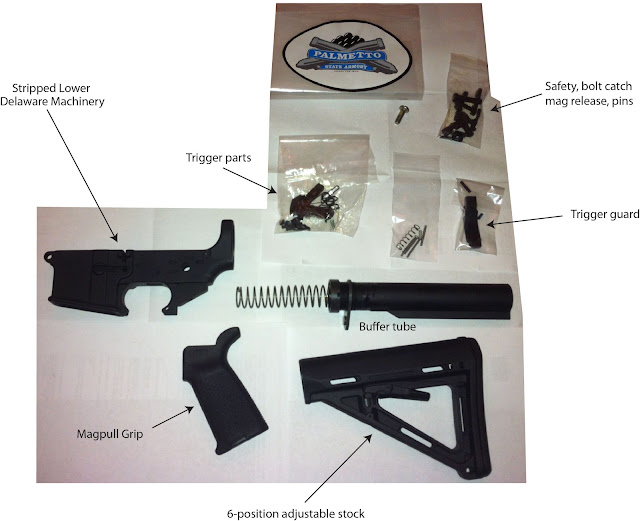
I chose the standard lower parts build kit from Palmetto State Armory - $109. Here's what you get for the money. Note: the stripped lower is not a part of the kit.

Wikipedia calls it:
The AR-15 is a lightweight, 5.56 mm, magazine-fed, semi-automatic rifle, with a rotating-lock bolt, actuated by direct impingement gas operation or long/short stroke piston operation. It is manufactured with the extensive use of aluminum alloys and synthetic materials.
The AR-15 was first built by ArmaLite as a selective fire assault rifle for the United States armed forces. Because of financial problems, ArmaLite sold the AR-15 design to Colt. The select-fire AR-15 entered the US military system as the M16 rifle. Colt then marketed the Colt AR-15 as a semi-automatic version of the M16 rifle for civilian sales in 1963.[8] The name "AR-15" is a Colt registered trademark, which refers only to the semi-automatic rifle.
For purposes of this post, I'll call it 'the rifle".
So how do you start building the rifle?

With this part - the "stripped lower".
This is the part that is classified by the ATF as the actual gun. This part will contain the trigger/hammer assembly, the safety, the bolt catch, and will accommodate the magazine and the buffer tube.
This part is manufactured following the original specifications (from the 60's) for the military version of the gun. The major difference is the military version (M16) has a "selective fire" option which allows automatic fire. The civilian version (AR15) does not. All manufacturers use exactly the same specifications for the part, dimensions and material. This makes for a huge source of lowers for the consumer, but also a choice. For example, there is virtually no difference between a $65 stripped lower made by ABC compnay and one that costs $185 - they're all made to the same specifications. Just depends which "name" you want people to see on the side.
The part I bought is manufactured by Delaware Machinery. Fit and finish is beautiful, anodized aluminum. $65
Now, this is where it gets interesting...
To build out the lower, you need a trigger/hammer assembly, springs, pins, a grip, a buffer tube, and a stock. And of course, you can customize every one of these parts. I chose to buy the "standard parts", predominantly because of availability but also due to cost. My target price on this rifle is <$600.
I chose the standard lower parts build kit from Palmetto State Armory - $109. Here's what you get for the money. Note: the stripped lower is not a part of the kit.

With some trial and error, I was able to get all the parts in place in about 45 minutes. The lower build kit I bought does not come with instructions or even a schematic - I found both on the internet. There are dozens of sources for schematics and hundreds of YouTube videos showing how to assemble the various parts of the lower. At least 10 minutes of the 45 was spent searching for the information. Once you know where the parts go, it's pretty simple to actually install them.
Here's where I am now with the parts installed:

Next step: find and purchase a complete upper (barrel, upper receiver, bolt carrier group, and charging handle). Stay tuned.
Sunday, September 23, 2012
Sighting the Target
 We need water to survive. It's more important than food. You need bullets to shoot a gun. And to hit the target, you need to aim. Aiming, or sighting, is not as easy as it sounds.
First of all, let's check your eyesight. Do you know which is your "dominant eye"? Here's a quick way to find out.
HOW TO DETERMINE YOUR DOMINANT EYE

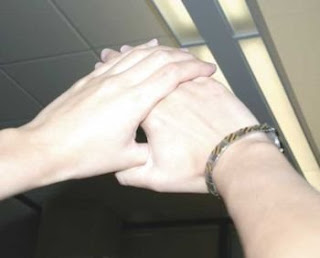
- First, form a triangle by clasping your hands like in the picture above. Hold your hands out in front of you.
- Next, with both eyes open, sight through the triangle and focus on an object. Don't focus on your hands.
- Close one eye. If you can still see the object in the triangle, then you're looking with your dominant eye. If not reverse the process.
When you see how the image shifts when you are not using your dominant eye, you can see how much that could effect your aim when sighting your gun.
The next issue to consider is your "sight picture". Briefly stated, that's the line formed between the rear sight and your final target. In reality, when you sight your gun, you're looking at the target, your rear sight, and somewhere in between is the front sight. This is your sight picture. But is it possible to focus on all those objects at the same time? The short answer is no.
While you won't be able to bring all of those objects into focus at the same time, it's important that you focus on the rear sight primarily and look through it to see your target. At this point, you'll see a fuzzy front sight. Without changing your focus, move the gun so the front sight moves into alignment with the rear sight. As long as you can see the target through your rear sight, you should now be "on target". Pull the trigger. Check your results.
Learn how to make this sight picture quickly. It's important in a self-defense situation, where you need to acquire the target as quickly as possible. Practice by lowering your gun after each shot, so you have to find the target every time. You'll get good at it with practice.
Friday, July 6, 2012
Bersa Thunder 380 Plus
I have to admit that there are very few things that "surprise" me. It's not that my expectations are low; I've just grown to accept that few products are going to make you smile when you first use them. The Bersa Thunder 380 Plus makes me smile.

First of all, fit and finish on the Bersa is first class. It is a solidly made gun; no rough edges, no obvious machining marks. Our particular sample has an alloy frame with a matte nickel slide. The "Plus" designation signifies that the model sports a 15 round magazine instead of the 7 round found in the standard Thunder 380. Total capacity is 15+1.
The 380 is chambered for the 380ACP round. While there is a lot of discussion about the merits of this round, the Bersa handles the ammuntion with ease. We shot several boxes of JHP without a single failure.
Out of the box, this gun is extremely accurate. At 7 yards, we were putting rounds into a three inch circle. At 20 oz empty, it has plenty of weight to help dissipate the recoil of the 380 round and feels very comfortable in the hand.
The action is DA/SA with a thumb safety which acts as a decocker. The pull weight on SA is very low. The rear sight is drift adjustable, although we didn't think it needed any adjustment in the short time we shot it.
If you're looking for a well-built, economical handgun, in a relatively compact frame, put the Bersa Thunder series on your list. At less than $400 retail, it is well worth the money.
Thursday, July 5, 2012
Triple Target Range
What better way to start off Independence Day than a trip to the shooting range? Wednesday morning, we went to Triple Target Range in Sophia, NC.

 |
| The check-in station at Triple Target Range. |
Located "in" Sophia, NC, Triple Target Range offers outdoor, covered shooting for rifles, pistols, and shotguns. We didn't visit the rifle section, although there were several people there as we passed by on our way to the pistol range.
The ranges are positioned in an arc and each section is approximately 15 degrees apart on that arc. That and the high earth berms make it impossible for any errant shots from any of the ranges hitting anybody at one of the others.
At the end of a long gravel road, Triple Target Range is a well-thought-out range where you get to shoot any or all of your weapons in a relaxed, outdoors, woodsy setting. Limited to firearms at this point, they are building stands for the archery range. Don't have any information at this point when to expect their access. Please check with the range directly.
While we didn't encounter any zombies at Triple Target, there was enough lead-slinging all around to pretty much put a "hurtin" on them if they had been there.

Triple Target Range in Sophia, NC. Owners Shelton and Joann Bradshaw. Check it out!
Saturday, June 9, 2012
Drive-By Shooting
You hear about them on the news and see it in the movies, but you never think you're actually going to be involved in one - a random drive-by shooting. My daughter and her son experienced that yesterday during lunch in the Charlotte (NC) area.
They were just sitting down, when a bullet came through the front door, striking the chair in which my daughter's son was just getting ready to sit in. It passed through an oak slat in the back and grazed his forearm. Fortunately, nobody was seriously hurt. The police later discovered the bullet (.22cal). They said this was the third time this type of event had occurred in that area.
 I guess that's why we sell guns. Seems like everyday, people are in situations where they need to protect themselves from the crazies and criminals out there. What if the shooter had actually come into the restaurant and started shooting innocent bystanders. You would want to either have a weapon to defend yourself or hope that somebody else there had a weapon to fight back.

We are fortunate and extremely happy that nobody got hurt. Unfortunately, there is somebody still out there that thinks it's perfectly okay to shoot into a crowded restaurant. Sad but true.
UPDATE: there were actually 6 shootings in a 12 hour period; apparently the shooter's target is automobiles.
See the coverage here:
http://www.wsoctv.com/news/news/6-shootings12-hours-has-charlotte-residents-high/nPP6j/
They were just sitting down, when a bullet came through the front door, striking the chair in which my daughter's son was just getting ready to sit in. It passed through an oak slat in the back and grazed his forearm. Fortunately, nobody was seriously hurt. The police later discovered the bullet (.22cal). They said this was the third time this type of event had occurred in that area.


We are fortunate and extremely happy that nobody got hurt. Unfortunately, there is somebody still out there that thinks it's perfectly okay to shoot into a crowded restaurant. Sad but true.
UPDATE: there were actually 6 shootings in a 12 hour period; apparently the shooter's target is automobiles.
See the coverage here:
http://www.wsoctv.com/news/news/6-shootings12-hours-has-charlotte-residents-high/nPP6j/
Subscribe to:
Posts (Atom)